STEFANO FAKE & THE FAKE FACTORY “LIQUID COLOURS” (digital version) – 2012 > today — An Immersive Art Installation

STEFANO FAKE & THE FAKE FACTORY “LIQUID COLOURS” (digital version) – 2012 > today — An Immersive Art Installation

Liquid Colours (2012), created by Stefano Fake and The Fake Factory, is an immersive art installation in which spectators are enveloped by a continuous videoprojection of evolving chromatic fields and fluid forms. The work abandons fixed pictorial composition in favor of dynamic visual flux, producing an environment that is both sensorially overwhelming and aesthetically contemplative.

At its core, the installation functions as an expanded field of color: the projection surfaces dissolve the boundaries of the exhibition space, creating a seamless, immersive continuum. Within this continuum, abstract shapes emerge, transform, and dissolve, echoing organic processes such as flow, mutation, and metamorphosis. The resulting aesthetic experience situates the viewer within a living chromatic organism, one that resists stasis and instead privileges perpetual transformation.

From a phenomenological perspective, Liquid Colours emphasizes embodied perception. The spectator is not positioned as an external observer of an image but rather as a subject immersed in an atmospheric field of light and color. This aligns with Maurice Merleau-Ponty’s theorization of perception as situated, embodied, and inseparable from spatial experience. The spectator’s bodily presence within the projection environment is constitutive of the work, as perception itself becomes the site of aesthetic realization.

In terms of digital aesthetics, the installation foregrounds the generative capacity of video projection to produce continuous transformation. Unlike traditional visual art forms, which rely on permanence and materiality, Liquid Colour privileges ephemerality, flux, and immateriality. Here, color is not applied to a canvas but exists as light in motion, unfolding in real time across architectural space. The artwork thus destabilizes the distinction between object and environment, transforming exhibition space into an experiential landscape.

Ultimately, Liquid Colours exemplifies The Fake Factory’s broader artistic philosophy: to dissolve the boundaries between art and spectator, image and environment, physical presence and perceptual field.

The early 2000s marked the crystallization of immersive art as a distinct artistic practice, driven by advances in video projection, digital animation, and interactive technologies. While earlier 20th-century avant-gardes had experimented with spatial environments (e.g., environments of the 1960s, light art of the 1970s), the advent of high-resolution projection systems and computer-generated animation enabled artists to transform entire architectural spaces into dynamic, multisensory environments.

In contrast to traditional art forms, where the artwork is framed and external to the spectator, immersive art envelops the viewer, placing them inside the work. Walls, ceilings, and sometimes floors become projection surfaces, and digital animations introduce perpetual transformation into the experience. This results in a mode of art that is total, atmospheric, and experiential, often described as “stepping inside a painting” or “being absorbed into a visual and sonic world.”

Digital projection and animation allow for artworks that are not fixed but continually evolving. This emphasis on flux and impermanence contrasts with the material stability of painting or sculpture. By integrating architecture, sound, and light, immersive art collapses the boundaries between artistic disciplines, aligning with theories of the “expanded field” of art.

Artists such as Stefano Fake, founder of The Fake Factory, have been central to the development and popularization of immersive art.

Fake’s practice emphasized site-specific projection environments that transformed entire spaces into sensorial landscapes. His installations blurred distinctions between observer and participant, often positioning the audience as integral to the unfolding of the artwork. 

Immersive art, as pioneered by Stefano Fake and contemporaries, represents a decisive shift in artistic production and reception:

  • From object-based art to experience-based art.
  • From fixed materiality to dynamic digital flux.
  • From passive spectatorship to active participation and co-creation.

It reflects broader cultural changes in the early 21st century: the rise of digital technologies, the growing emphasis on experiential culture, and the reconfiguration of art as an event rather than an object. Immersive art, born at the turn of the 21st century through the use of video projections and digital animation, has transformed the way we conceive artistic experience. Artists such as Stefano Fake played a foundational role in this innovation, not only pioneering the technical and aesthetic possibilities of immersive installations but also redefining the role of the spectator.
Presence by Stefano Fake & The Fake Factory (2022–present)

Presence by Stefano Fake & The Fake Factory (2022–present)

Presence is an interactive installation conceived by Stefano Fake and The Fake Factory, with the technical design framework developed in TouchDesigner by Alberto Gennaro. This work foregrounds a central theme in The Fake Factory’s creative philosophy: the physical presence of the audience as active agents within the artwork. Rather than mere observers, visitors become integral performers whose movements dynamically shape both gestural choreography and chromatic composition within the installation. 

Interactive installations constitute a form of artistic practice that actively solicits audience participation, whether through technological mediation or handcrafted mechanisms. These works are frequently kinetic in nature, transforming static objects into dynamic, participatory experiences. By foregrounding interaction, such installations challenge conventional modes of spectatorship associated with traditional art forms, shifting the emphasis from passive observation to active engagement and immersion.

The artwork under discussion exemplifies this shift. Unlike prerecorded or pre-rendered visual material, the installation generates imagery in real time, continuously shaped by the interaction between participants and the system. As viewers position themselves before the screens, their silhouettes are captured and reconfigured into abstract visual forms.

This process is facilitated through the integration of Kinect sensors and cameras, which register bodily movements and gestures. The captured data is then translated into evolving visual representations, producing an environment in which participants witness abstracted versions of themselves projected within the artwork.

Such installations not only engage audiences but also invite them to experiment with their own corporeal gestures as vehicles of artistic expression. In doing so, they destabilize the boundary between physical and digital domains, offering an evolving, generative encounter with art that is both participatory and immersive.

The aesthetic and conceptual DNA of Presence echoes early video-art experiments, notably Norman McLaren’s Pas de deux (1968), and Stefano Fake’s own explorations in the early 2000s, such as The Essence of Dance (2004–2005). In this contemporary installation, the traditional dancer is replaced by the everyday museum-goer, effectively democratizing the role of performer and redefining immersive art as a participatory space where anyone—instinctively—becomes central to the experience.

Visitors physically engage with the installation through movement, generating infinite gestural and color sequences in real time. The body becomes both instrument and catalyst: every shift produces a visual response, turning improvisational motion into vivid chromatic expression iicedimburgo.esteri.it+1. This capacity for co-creation in the moment imbues Presence with a sense of immediacy and unpredictability that is both aesthetically striking and emotionally resonant.

As one of the most significant immersive artworks of recent years, Presence builds upon and advances the tradition of experiential art pioneered by Stefano Fake. The work exemplifies the studio’s mission to dissolve the boundary between spectator and artwork, empowering visitors to inhabit, shape, and transform the visual environment in real time.

STEFANO FAKE & THE FAKE FACTORY “THE ART OF COLOURS” Light Art Installation (2012 – today)

STEFANO FAKE & THE FAKE FACTORY “THE ART OF COLOURS” Light Art Installation (2012 – today)

The Art of Colours is an evolving immersive installation that explores the transformative power of light and color, using space to engage the visitor’s perceptual faculties. The installation generates a sensory dialogue between the artwork and the viewer, inviting a phenomenological experience where art and perception merge.

Originally conceived in 2012, this installation has been presented in varied, site-specific contexts—most notably during Milan’s Fuorisalone (the global hub of Design Week) and Florence’s Light Festival, which began that same year. 

In typical Fake Factory style, the artwork transcends passivity: the visitor’s physical presence becomes integral to the color and light interplay. Walking into the installation, the viewer’s silhouette, movement, or proximity can modulate how color fields shift, blend, and interact—thus shifting the artwork dynamically in response to human presence .

Much like Stefano Fake’s earlier immersive works, The Art of Colours is oriented around the visitor’s embodied experience. It offers a dynamic perceptual field where the boundary between self and environment blurs—a cornerstone of Merleau-Ponty’s theories on embodied perception. Participants do not merely observe the installation; they enact and co-create it.

Rather than plot or narrative, The Art of Colours communicates through color and forms. This aligns with an interpretation of light as a semiotic medium—evoking emotional responses and sensory resonance in lieu of explicit representation. The absence of figurative imagery places emphasis on abstract affective experience.

In the new millenium, digital art had begun shifting away from the spectacle of technology toward immersive, embodied experiences. The Art of Colours exemplifies this shift: the technology—projections, sensors, lighting—is designed to vanish into the experience itself. What remains is the perception—pure, immediate, and orchestrated through color and movement.

In The Art of Colours, light and color are not fixed—they shift in relation to the physical presence of the audience. The human body becomes part of the feedback loop, functioning almost like a brushstroke in a living digital canvas.

  • Traditional art situates the viewer as an external spectator, but here, simply being in the space alters the artwork.
  • Viewers walking, standing still, or interacting with one another cause color fields to ripple, blend, or shift.
  • This creates a personalized and collective aesthetic journey:
  • Personalized: each visitor’s presence generates unique variations.
  • Collective: multiple visitors can transform the environment together, creating layered dynamics of light.

This makes the artwork inherently unrepeatable: no two moments are identical because the composition emerges from lived presence.

Phenomenological lens:

The installation amplifies Merleau-Ponty’s idea of the body as the locus of perception. The viewer perceives light, but also perceives themselves as a generator of light transformations. The boundaries between self and artwork blur.

Digital aesthetic lens:

The role of technology is not to be showcased but to disappear into experience. Instead of seeing “a computer program,” the visitor perceives “a world of shifting colors that respond to me.” This situates The Art of Colours within post-digital practice, where the focus lies on human experience, not technological novelty.

Implications of Modulated Environments

  • Agency: The visitor gains agency in shaping their aesthetic environment—art is no longer delivered, but co-created.
  • Relationality: The artwork is relational (Bourriaud): what matters is not an object on the wall, but the relationship between light, space, and the embodied visitor.
  • Ephemeral Art: Since each moment is tied to a presence, the artwork only “exists” in its full sense when it is inhabited—without presence, it collapses back into potentiality.

 The viewer presence actively modulates sensory environment:

  • The body is not external but constitutive of the artwork.
  • Presence and absence directly alter the visual outcome.
  • The environment is responsive, ephemeral, and relational—existing only through the ongoing co-production between visitor and system.

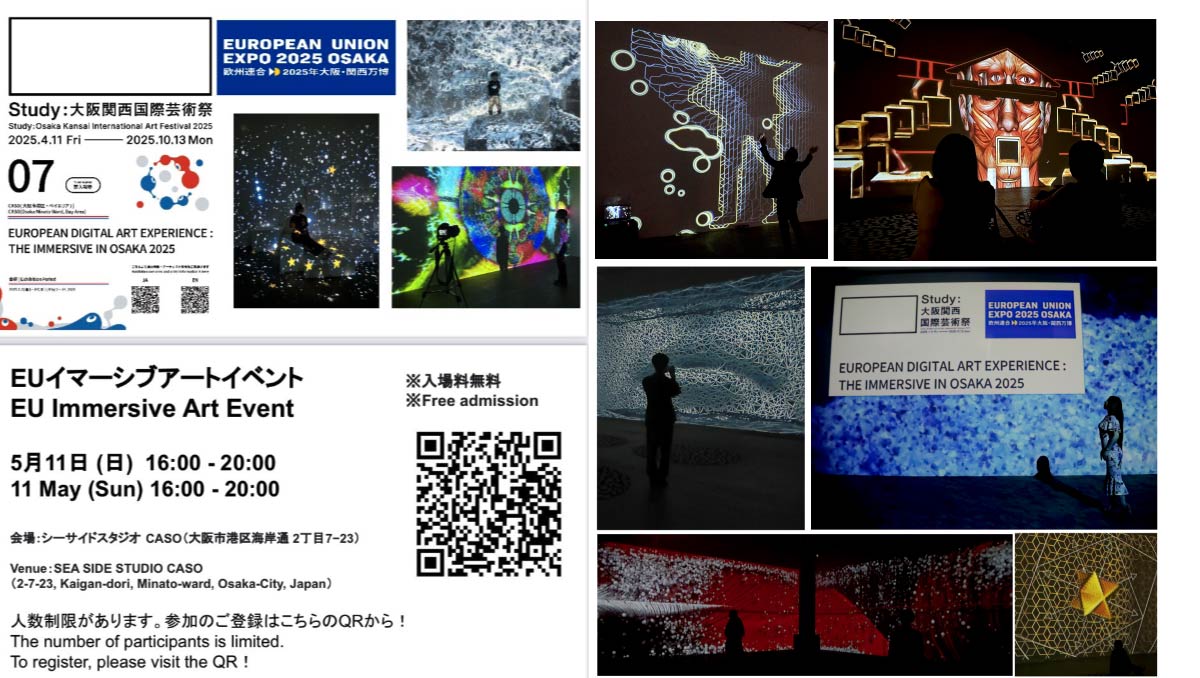
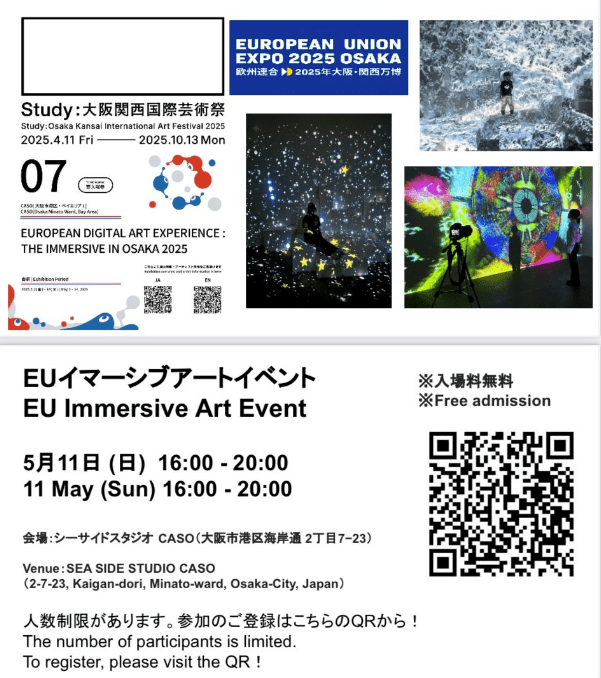
EUROPEAN DIGITAL ART EXPERIENCE : THE IMMERSIVE IN OSAKA 2025

EUROPEAN DIGITAL ART EXPERIENCE : THE IMMERSIVE IN OSAKA 2025

欧州連合(EU)が主催する文化プログラムの一環で、「Study: 大阪関西国際芸術祭2025」の連

携企画として、2025年5月14日まで、シーサイドスタジオCASO(コンテンポラリー・アート・スペー

ス大阪)にて、イマーシブ・デジタルアートの展覧会を開催しています。

本展では、ヨーロッパ各国から集まった28組の才能あふれるアーティストによる、革新性と創造

性に富んだ作品を紹介します。

この展覧会は、EU対外行動庁(EEAS)および駐日EU代表部の企画により実現したもので、現

代ヨーロッパのデジタルアートが持つ多様でダイナミックな表現世界を、日本の皆さまにご体験い

ただくことを目的としています。

出展作品を通して、現在のアートシーンにおけるトレンドやアイデアが反映されており、テクノロ

ジーと芸術が融合する、新たな表現のかたちをご覧いただけます。

本展ではデジタルとリアルの境界を越える作品と出会い、

ヨーロッパと日本、双方の文化が交わる貴重な場となり、イマーシブ・アートが拓く未来の可能性

を感じながら、ぜひ多くの対話とつながりを育んでいただければ幸いです。

European media artists on show:

JÉRÉMIE BELLOT / APPARATI EFFIMERI / ÁNGEL SANDIMAS & AMAYA MADRIGAL /

THE FAKE FACTORY / PHILIPP GEIST / OOOPSTUDIO / SÉBASTIEN LABRUNIE / FULL

FRAMES / INZIST / FLxER / BETTY MÜ / LUCA AGNANI / MP-STUDIO / KANAKA

STUDIO / OCUBO / OLO CREATIVE FARM / ROCCO HELMCHEN & JOHANNES KRAAS /

TELENOIKA / PIXEL SHAPES / H3 / MOULAB COLLECTIVE / JONAS DENZEL / WÖA

STUDIO / PANI PAWLOSKY / MICHELE PUSCEDDU / MOMAP STUDIO / LEANDRO

SUMMO / DARK LIGHT STUDIO

Art curator: Stefano FAKE氏 プロフィール

@immersive_art_experiences

@study_okiaf

@euatexpo

@euinjapan

@euculturejapan

@seaside_studio_caso

@immersiveartexperience

#EUatExpo

#EUDay

#欧州連合

#study_okif

#study大阪関西国際芸術祭

#immersiveart

#immersiveartexperience

#osakaexpo2025

#EXPO2025

#大阪関西万博

#videomapping

#digitalart

#newmediaart

#projectionmapping

#ContemporaryArt

#ArtExperience

#ImmersiveExperience

#ImmersiveArtExperience

In the framework of the European Union cultural programme for the International EXPO 2025 in Osaka and of the “Study: Osaka Kansai International Art Festival 2025,” an exhibition featuring immersive digital art will be on display at the Contemporary Art Space Osaka (CASO) until May 14, 2025. This exhibition showcases the inspiring work of 28 talented European artists.

The European Union  External Action Service (EEAS) with the EU Delegation in Japan aims to introduce the vibrant world of contemporary European digital art to Japanese audiences. Through this diverse collection of artworks, visitors will see innovative and imaginative creations that reflect current trends and ideas in the art world. 

The exhibition provides a unique opportunity for attendees to engage with artworks that blurs the lines between technology and creativity. This event promises to be a highly enjoyable experience, encouraging conversations and connections between European and Japanese cultures while celebrating the exciting possibilities of digital art.

@study_okiaf

@euatexpo

@euinjapan

@euculturejapan

@seaside_studio_caso

#EUatExpo

#EUDay

#study_okif

#immersiveart

#immersiveartexperience

#osakaexpo2025

#osakaexpo

#EXPO2025

MediaArt

#videomapping

#digitalart

#newmediaart

#projectionmapping

#ContemporaryArt

#ArtExperience

#ImmersiveExperience

#ImmersiveArtExperience

European media artists on show:

JÉRÉMIE BELLOT /  APPARATI EFFIMERI /  ÁNGEL SANDIMAS & AMAYA MADRIGAL /  THE FAKE FACTORY /  PHILIPP GEIST / OOOPSTUDIO / SÉBASTIEN LABRUNIE /  FULL FRAMES / INZIST /  FLxER /  BETTY MÜ / LUCA AGNANI / MP-STUDIO / KANAKA STUDIO / OCUBO / OLO CREATIVE FARM / ROCCO HELMCHEN & JOHANNES KRAAS / TELENOIKA / PIXEL SHAPES / H3 / MOULAB COLLECTIVE / JONAS DENZEL / WÖA STUDIO / PANI PAWLOSKY / MICHELE PUSCEDDU / MOMAP STUDIO / LEANDRO SUMMO / DARK LIGHT STUDIO

Art curator: Stefano FAKE氏 プロフィール

@immersive_art_experiences

LEUCHTENDE FREIHEIT LEIPZIG – Immersive audiovisual experience – KKW LEIPZIG 2024

LEUCHTENDE FREIHEIT LEIPZIG – Immersive audiovisual experience – KKW LEIPZIG 2024

LEUCHTENDE FREIHEIT
Die Friedliche Revolution 1989 Immersiv Erleben

Im Oktober 2024 jährt sich die große Montagsdemonstration in Leipzig zum 35. Mal.
Mit einer multimedialen, immersiven Installation wollen wir Menschen in die Zeit der Proteste von 1989 zurückversetzen. Eine atmosphärische, bild- und klangreiche Umgebung wird geschaffen, die die Anspannung, Angst, aber auch den Mut und die Hoffnung der damaligen Zeit erlebbar macht. Die Besucher werden mitten in die Montagsdemonstration hineinversetzt und durch die Integration von Bild-, Film- und Tonmaterial ein „Gänsehaut“ Erlebnis erfahren, das zum Nachdenken über den revolutionären Aufbruch anregt.

“Ein emotionales Erlebnis voller Geschichte und Erinnerung…”

LEUCHTENDE FREIHEIT 🕯️
Die Friedliche Revolution 1989 Immersiv Erleben

Im Oktober 2024 jährt sich die große Montagsdemonstration – in Leipzig zum 35. Mal.
Mit einer multimedialen, immersiven Installation wollen wir Menschen in die Zeit der Proteste von 1989 zurückversetzen.

Eine atmosphärische, bild- und klangreiche Umgebung wird geschaffen, die die Anspannung, Angst, aber auch den Mut und die Hoffnung der damaligen Zeit erlebbar macht.
Die Besucher werden mitten in die Montagsdemonstration hineinversetzt und durch die Integration von Bild-, Film- und Tonmaterial ein “Gänsehaut” Erlebnis erfahren, das zum Nachdenken über den revolutionären Aufbruch anregt.

Ein emotionales Erlebnis voller Geschichte und Erinnerung…

MONTAG, 7. OKTOBER 2024

IMMERSIVE ART INSTALLATIONS (2001-2024)

STEFANO FAKE & THE FAKE FACTORY
IMMERSIVE ART EXPERIENCES (2001-today)

Stefano Fake è un artista e video designer italiano, che realizza installazioni utilizzando video proiezioni, film, fotografie, sculture, computer grafica e tecnologie interattive. E’ fra i principali esponenti della IMMERSIVE ART, che si propone di immergere lo spettatore all’interno dell’opera d’arte stessa. Nel 2001 fonda a Firenze il suo laboratorio THE FAKE FACTORY, che in pochi anni diventa un punto di riferimento internazionale nelle arti immersive e nelle scenografie digitali per teatro, concerti ed eventi. 
Stefano Fake si propone di rompere la tradizionale separazione creatore-fruitore mettendo lo spettatore al centro dell’esperienza d’arte. Utilizzando i linguaggi e le tecnologie digitali in uso nelle scenografie teatrali e cinematografiche, crea delle Immersive Rooms, ambienti multi-sensoriali immersivi dove il pubblico non è solo spettatore ma diviene attore protagonista dell’opera stessa. L’arte immersiva è una forma d’arte che utilizza video proiezioni, luci, suoni, musiche, e a volte anche essenze profumate e micro-dosi di superfood per avvolgere e coinvolgere lo spettatore in una esperienza d’arte totalizzante, stimolandone i sensi e attivandone le emozioni. 

Per molti musei diventa un’opportunità di rinnovamento delle regole della fruizione. 

Un progetto innovativo che tende a scuotere e coinvolgere l’osservatore sia sul piano sensoriale che su quello intellettuale, suggerendo e stimolando nuove letture visive, narrative, critiche e pedagogiche sull’Arte Moderna e Contemporanea. 

STEFANO FAKE & THE FAKE FACTORY

Stefano Fake (born 7th October 1971 – not dead yet), is an Italian artist and video designer, who creates installations using video projections, films, photographs, sculptures, computer graphics and interactive technologies. He is a pioneer and one of the main authors of Immersive Art Installations, which aims to immerse the viewer inside the work of art itself. Graduated in Political Science in Milan, he studied film making and digital videoproduction in Madrid, New York, Los Angeles. From 1997 to 2007 he was in charge of developing the virtual sets of the avant-garde Krypton Theater Company of Florence. In 2001 he founded THE FAKE FACTORYy, an art studio that becomes an international reference point of IMMERSIVE ART EXPERIENCES, participating in the realisation of multi-disciplinary art projects: immersive art exhibitions, video-mapping projections, architectural light installations, video production, video sets for theatre, fashion shows, visual environments for museums, galleries and cultural events, production of multi-sensory experiences, video installations, video art works. STEFANO FAKE Immersive Art exhibitions have been attended by millions of visitors around the world.

stefanofake.com
thefakefactory.com
immersiveexperience.com
immersivemirrorroom.com

IG @immersiveartexperience