STEFANO FAKE & THE FAKE FACTORY “THE ART OF COLOURS” Light Art Installation (2012 – today)

STEFANO FAKE & THE FAKE FACTORY “THE ART OF COLOURS” Light Art Installation (2012 – today)

The Art of Colours is an evolving immersive installation that explores the transformative power of light and color, using space to engage the visitor’s perceptual faculties. The installation generates a sensory dialogue between the artwork and the viewer, inviting a phenomenological experience where art and perception merge.

Originally conceived in 2012, this installation has been presented in varied, site-specific contexts—most notably during Milan’s Fuorisalone (the global hub of Design Week) and Florence’s Light Festival, which began that same year. 

In typical Fake Factory style, the artwork transcends passivity: the visitor’s physical presence becomes integral to the color and light interplay. Walking into the installation, the viewer’s silhouette, movement, or proximity can modulate how color fields shift, blend, and interact—thus shifting the artwork dynamically in response to human presence .

Much like Stefano Fake’s earlier immersive works, The Art of Colours is oriented around the visitor’s embodied experience. It offers a dynamic perceptual field where the boundary between self and environment blurs—a cornerstone of Merleau-Ponty’s theories on embodied perception. Participants do not merely observe the installation; they enact and co-create it.

Rather than plot or narrative, The Art of Colours communicates through color and forms. This aligns with an interpretation of light as a semiotic medium—evoking emotional responses and sensory resonance in lieu of explicit representation. The absence of figurative imagery places emphasis on abstract affective experience.

In the new millenium, digital art had begun shifting away from the spectacle of technology toward immersive, embodied experiences. The Art of Colours exemplifies this shift: the technology—projections, sensors, lighting—is designed to vanish into the experience itself. What remains is the perception—pure, immediate, and orchestrated through color and movement.

In The Art of Colours, light and color are not fixed—they shift in relation to the physical presence of the audience. The human body becomes part of the feedback loop, functioning almost like a brushstroke in a living digital canvas.

  • Traditional art situates the viewer as an external spectator, but here, simply being in the space alters the artwork.
  • Viewers walking, standing still, or interacting with one another cause color fields to ripple, blend, or shift.
  • This creates a personalized and collective aesthetic journey:
  • Personalized: each visitor’s presence generates unique variations.
  • Collective: multiple visitors can transform the environment together, creating layered dynamics of light.

This makes the artwork inherently unrepeatable: no two moments are identical because the composition emerges from lived presence.

Phenomenological lens:

The installation amplifies Merleau-Ponty’s idea of the body as the locus of perception. The viewer perceives light, but also perceives themselves as a generator of light transformations. The boundaries between self and artwork blur.

Digital aesthetic lens:

The role of technology is not to be showcased but to disappear into experience. Instead of seeing “a computer program,” the visitor perceives “a world of shifting colors that respond to me.” This situates The Art of Colours within post-digital practice, where the focus lies on human experience, not technological novelty.

Implications of Modulated Environments

  • Agency: The visitor gains agency in shaping their aesthetic environment—art is no longer delivered, but co-created.
  • Relationality: The artwork is relational (Bourriaud): what matters is not an object on the wall, but the relationship between light, space, and the embodied visitor.
  • Ephemeral Art: Since each moment is tied to a presence, the artwork only “exists” in its full sense when it is inhabited—without presence, it collapses back into potentiality.

 The viewer presence actively modulates sensory environment:

  • The body is not external but constitutive of the artwork.
  • Presence and absence directly alter the visual outcome.
  • The environment is responsive, ephemeral, and relational—existing only through the ongoing co-production between visitor and system.

LEUCHTENDE FREIHEIT LEIPZIG – Immersive audiovisual experience – KKW LEIPZIG 2024

LEUCHTENDE FREIHEIT LEIPZIG – Immersive audiovisual experience – KKW LEIPZIG 2024

LEUCHTENDE FREIHEIT
Die Friedliche Revolution 1989 Immersiv Erleben

Im Oktober 2024 jährt sich die große Montagsdemonstration in Leipzig zum 35. Mal.
Mit einer multimedialen, immersiven Installation wollen wir Menschen in die Zeit der Proteste von 1989 zurückversetzen. Eine atmosphärische, bild- und klangreiche Umgebung wird geschaffen, die die Anspannung, Angst, aber auch den Mut und die Hoffnung der damaligen Zeit erlebbar macht. Die Besucher werden mitten in die Montagsdemonstration hineinversetzt und durch die Integration von Bild-, Film- und Tonmaterial ein „Gänsehaut“ Erlebnis erfahren, das zum Nachdenken über den revolutionären Aufbruch anregt.

“Ein emotionales Erlebnis voller Geschichte und Erinnerung…”

LEUCHTENDE FREIHEIT 🕯️
Die Friedliche Revolution 1989 Immersiv Erleben

Im Oktober 2024 jährt sich die große Montagsdemonstration – in Leipzig zum 35. Mal.
Mit einer multimedialen, immersiven Installation wollen wir Menschen in die Zeit der Proteste von 1989 zurückversetzen.

Eine atmosphärische, bild- und klangreiche Umgebung wird geschaffen, die die Anspannung, Angst, aber auch den Mut und die Hoffnung der damaligen Zeit erlebbar macht.
Die Besucher werden mitten in die Montagsdemonstration hineinversetzt und durch die Integration von Bild-, Film- und Tonmaterial ein “Gänsehaut” Erlebnis erfahren, das zum Nachdenken über den revolutionären Aufbruch anregt.

Ein emotionales Erlebnis voller Geschichte und Erinnerung…

MONTAG, 7. OKTOBER 2024

IMMERSIVE ART INSTALLATIONS (2001-2024)

STEFANO FAKE & THE FAKE FACTORY
IMMERSIVE ART EXPERIENCES (2001-today)

Stefano Fake è un artista e video designer italiano, che realizza installazioni utilizzando video proiezioni, film, fotografie, sculture, computer grafica e tecnologie interattive. E’ fra i principali esponenti della IMMERSIVE ART, che si propone di immergere lo spettatore all’interno dell’opera d’arte stessa. Nel 2001 fonda a Firenze il suo laboratorio THE FAKE FACTORY, che in pochi anni diventa un punto di riferimento internazionale nelle arti immersive e nelle scenografie digitali per teatro, concerti ed eventi. 
Stefano Fake si propone di rompere la tradizionale separazione creatore-fruitore mettendo lo spettatore al centro dell’esperienza d’arte. Utilizzando i linguaggi e le tecnologie digitali in uso nelle scenografie teatrali e cinematografiche, crea delle Immersive Rooms, ambienti multi-sensoriali immersivi dove il pubblico non è solo spettatore ma diviene attore protagonista dell’opera stessa. L’arte immersiva è una forma d’arte che utilizza video proiezioni, luci, suoni, musiche, e a volte anche essenze profumate e micro-dosi di superfood per avvolgere e coinvolgere lo spettatore in una esperienza d’arte totalizzante, stimolandone i sensi e attivandone le emozioni. 

Per molti musei diventa un’opportunità di rinnovamento delle regole della fruizione. 

Un progetto innovativo che tende a scuotere e coinvolgere l’osservatore sia sul piano sensoriale che su quello intellettuale, suggerendo e stimolando nuove letture visive, narrative, critiche e pedagogiche sull’Arte Moderna e Contemporanea. 

STEFANO FAKE & THE FAKE FACTORY

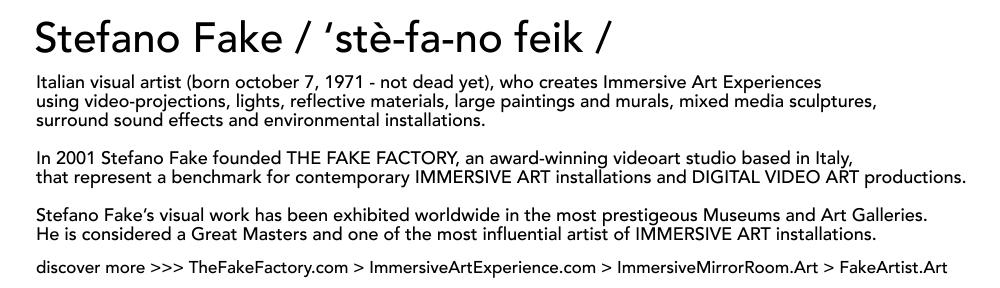
Stefano Fake (born 7th October 1971 – not dead yet), is an Italian artist and video designer, who creates installations using video projections, films, photographs, sculptures, computer graphics and interactive technologies. He is a pioneer and one of the main authors of Immersive Art Installations, which aims to immerse the viewer inside the work of art itself. Graduated in Political Science in Milan, he studied film making and digital videoproduction in Madrid, New York, Los Angeles. From 1997 to 2007 he was in charge of developing the virtual sets of the avant-garde Krypton Theater Company of Florence. In 2001 he founded THE FAKE FACTORYy, an art studio that becomes an international reference point of IMMERSIVE ART EXPERIENCES, participating in the realisation of multi-disciplinary art projects: immersive art exhibitions, video-mapping projections, architectural light installations, video production, video sets for theatre, fashion shows, visual environments for museums, galleries and cultural events, production of multi-sensory experiences, video installations, video art works. STEFANO FAKE Immersive Art exhibitions have been attended by millions of visitors around the world.

stefanofake.com
thefakefactory.com
immersiveexperience.com
immersivemirrorroom.com

IG @immersiveartexperience