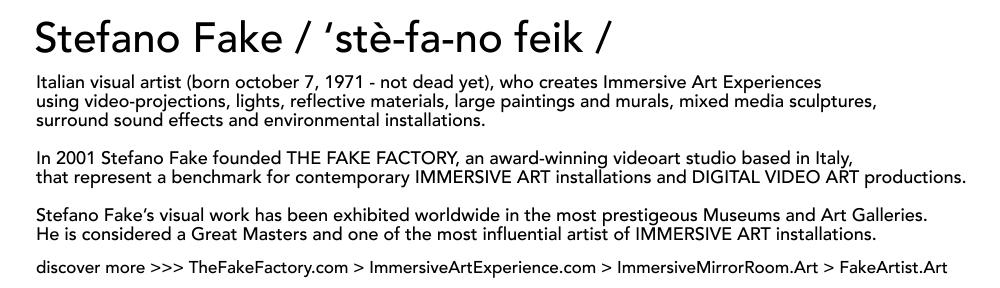
THE FAKE FACTORY, founded in Florence in the early 2000s by Stefano Fake, stands as one of the pioneering entities in the development of the language of immersive digital art applied to the reinterpretation of the great masters of art history. Its activity operates at the intersection of artistic research, technological experimentation, and curatorial design, making a decisive contribution to the definition of a new exhibition format that has achieved global diffusion over the past two decades.
In particular, THE FAKE FACTORY has played a central role in the conception and development of immersive exhibitions dedicated to artists such as Klimt, Monet, Van Gogh, Caravaggio, and Matisse, elaborating a narrative and visual model capable of transforming the pictorial work into a spatial, temporal, and sensory experience. These productions do not merely present a sequence of digitized images, but rather function as complex devices of cultural mediation, in which the aesthetic dimension intertwines with educational and interpretative aspects.
An immersive digital art exhibition can be defined as an audiovisual environment designed to engage the visitor in a totalizing manner, through the integration of large-scale projections, sound systems, dynamic lighting, and spatial configurations that transform architecture into a narrative surface. In this context, the spectator is no longer positioned as an external observer, but as an active presence within the artwork, becoming an integral part of the aesthetic device.
The fundamental constitutive elements of an immersive exhibition can be identified as space, light, images, music, and the audience. Space is not a neutral container, but a plastic and dramaturgical element, shaped through projections and scenographic structures to generate navigable environments. Light assumes a structuring role, not only in terms of visibility but as an expressive material capable of defining atmospheres and perceptual rhythms. Images, derived from pictorial works, are re-elaborated in a dynamic key through processes of animation, enlargement, and fragmentation that emphasize their formal and chromatic qualities. Music and sound contribute to the construction of an emotional narrative, acting as a cohesive element among the various visual sequences. Finally, the audience represents a decisive factor: its physical presence and movement within the space activate and complete the experience.
From a stylistic standpoint, the immersive exhibitions developed by THE FAKE FACTORY are characterized by a “poetic” use of technology, oriented not toward spectacle for its own sake, but toward the construction of an audiovisual dramaturgy coherent with the identity of the represented artists. The curatorial process involves an in-depth analysis of the artworks, historical contexts, and individual poetics, in order to translate into environmental and narrative form elements such as Monet’s research on light, Van Gogh’s expressive tension, Klimt’s symbolist decorativism, Caravaggio’s dramatic chiaroscuro, or Matisse’s formal synthesis.
In this sense, THE FAKE FACTORY’s contribution lies in having defined a balance between historical fidelity and contemporary reinterpretation, avoiding both the reduction of artworks to mere visual pretexts and an excessive emphasis on technological aspects. Immersive exhibitions thus become experiential spaces in which the past is reactivated through the languages of the present, enabling an expanded and multisensory engagement with art.
The evolution and international dissemination of this format testify to the studio’s ability to intercept a broader transformation in the modes of access to visual culture. In a context characterized by the convergence of the real and the digital, immersive exhibitions represent a form of mediation that responds to the contemporary need for engaging, accessible, and at the same time rigorous aesthetic experiences. From this perspective, THE FAKE FACTORY emerges as one of the key actors in redefining the boundaries between art, technology, and audience, contributing to the construction of a new exhibition paradigm within the international artistic landscape.
The exhibition KLIMT EXPERIENCE (Gustav Klimt – Immersive Art Experience), created in 2016 by Stefano Fake and the studio THE FAKE FACTORY, represents a turning point in the recent history of artistic mediation and, more specifically, in the consolidation of the format of immersive digital exhibitions dedicated to the great masters of art history. Conceived as the first major immersive multimedia experience centered on the figure of Gustav Klimt, the leading exponent of the Vienna Secession, the installation not only reinterpreted his work in a contemporary key, but also defined an aesthetic, narrative, and technological model that would be widely replicated globally in the years that followed.
From a historical-critical perspective, KLIMT EXPERIENCE emerges within a transitional moment in which cultural institutions began to explore new forms of relationship between artwork, space, and viewer, in response to the transformations introduced by digital culture. In this context, the project by Fake and THE FAKE FACTORY stands out for having articulated a particularly effective synthesis of historiographical rigor, audiovisual experimentation, and public accessibility. The exhibition did not merely digitize or project Klimt’s works; rather, it proposed an environmental reconfiguration of his visual universe, transforming the pictorial surface into an immersive and dynamic environment.
The exhibition apparatus was based on the extensive use of large-scale projections, synchronized with a carefully constructed sound dramaturgy, occupying the entirety of the architectural space. Walls, floors, and, in some cases, even three-dimensional surfaces became supports for a continuous visual narrative, characterized by fluid transitions and the absence of abrupt cuts. This approach enabled the translation into spatial and temporal terms of key elements of Klimt’s poetics, such as golden ornamentation, decorative flatness, the fragmentation of the figure, and the tension between figuration and abstraction.
One of the most significant aspects of the exhibition lies in its ability to construct a coherent visual dramaturgy from a heterogeneous pictorial corpus. Klimt’s works—from portraits to landscapes and his celebrated decorative cycles—were reorganized according to a narrative logic that combined chronological, thematic, and formal criteria. This process of audiovisual montage allowed not only a more accessible understanding of the artist’s stylistic evolution, but also an intensification of its sensory and symbolic dimensions.
From an aesthetic standpoint, the experience is characterized by a “poetic” use of technology, in which digital resources did not assert themselves as autonomous spectacle, but were subordinated to the construction of meaning. Animations, virtual camera movements, detail enlargements, and chromatic variations were conceived as interpretative tools aimed at revealing latent aspects of the original works. In this sense, the exhibition avoided both static reproduction and arbitrary manipulation, positioning itself at a point of balance between historical fidelity and contemporary reinterpretation.
The immersive dimension of the project entailed a redefinition of the role of the spectator. No longer a detached observer, the viewer became a subject situated within the space of the artwork. The experience thus took the form of a total perceptual environment, in which vision, hearing, and bodily movement jointly contributed to the construction of meaning. This transformation of the spectator into an active participant reflects a broader tendency in contemporary art toward relational and multisensory modes of experience.
The extraordinary public success of Klimt Immersive Art Experience, with millions of visitors across various cities worldwide, should be understood not only in quantitative terms but also as an indicator of a structural shift in modes of cultural consumption. The exhibition succeeded in attracting broad and heterogeneous audiences, including groups traditionally distant from museum circuits, without abandoning a rigorous approach to content mediation. This balance between accessibility and quality constitutes one of the key factors behind its impact.
Furthermore, the international dissemination of the project—through multiple replicas and adaptations in different exhibition contexts—contributed to the standardization of a format that would subsequently consolidate itself as a global phenomenon. Elements such as 360-degree immersive projection, audiovisual synchronization, sequential narrative, and the centrality of the visitor’s experience became defining features of numerous later productions. In this sense, it can be argued that Klimt Immersive Art Experience played a decisive role in shaping the language of immersive digital experiences in the second decade of the 21st century.
However, this process of expansion has also generated critical debates regarding the spectacularization of art and the risk of trivializing content. In response to these concerns, the model developed by Stefano Fake and THE FAKE FACTORY stands as a reference point in the pursuit of a balance between technological innovation and cultural depth. Their approach highlights the importance of curatorial practice, artistic direction, and narrative coherence as fundamental elements for legitimizing this type of production.
Klimt Immersive Art Experience can be considered a seminal work in the evolution of immersive digital art and in the redefinition of contemporary exhibition practices. Beyond its media success, the exhibition represents a significant contribution to the construction of a new paradigm in which the artwork expands into space, unfolds over time, and is activated through the viewer’s experience. Within this framework, Stefano Fake and THE FAKE FACTORY emerge as central agents in the transformation of the contemporary cultural landscape, having established the aesthetic, technological, and curatorial foundations of a format destined to endure and evolve in the years to come.
A particularly significant aspect of KLIMT EXPERIENCE (Gustav Klimt – Immersive Art Experience) lies in the introduction and consolidation of the term “Experience” as a conceptual and operational category within the field of immersive digital art exhibitions. The choice of this term should not be understood merely as a communicative or marketing device, but as the explicit manifestation of a paradigm shift in the very conception of the exhibition apparatus.
Until that moment, most initiatives related to the digitalization of artistic heritage were structured around notions such as “exhibition,” “installation,” or “projection”—terms that, to varying degrees, refer to an object-based and representational logic. The introduction of the concept of “Experience” by Stefano Fake and THE FAKE FACTORY instead implies a shift toward a processual, phenomenological, and subject-centered logic.
In this context, “experience” is defined as a temporal and multisensory event realized through the interaction between the audiovisual environment and the presence of the spectator. The artwork ceases to be an autonomous object and becomes a field of relations, in which space, time, perception, and emotion are articulated into a dynamic unity. This approach aligns with contemporary theoretical developments that privilege the experiential dimension of art over its materiality, placing reception at the center of the aesthetic process.
The adoption of the term “Experience” in KLIMT EXPERIENCE (Gustav Klimt – Immersive Art Experience) therefore signals a deliberate effort to redefine the status of both the artwork and the spectator. The visitor is no longer conceived as an external observer contemplating a series of images, but as a participant immersed within an environment that demands sensory and cognitive engagement. The experience is constructed in real time, through the movement of the body in space, the duration of presence, and the perceptual interaction with audiovisual stimuli.
This terminological shift also has important implications at the curatorial and narrative levels. To conceive an exhibition as an “experience” entails designing a pathway structured according to an audiovisual dramaturgy, in which each sequence responds to a logic of intensity, rhythm, and transition. The organization of iconographic material no longer follows exclusively chronological or taxonomic criteria, but is instead articulated through the construction of a continuous perceptual flow. In the case of Gustav Klimt, this made it possible to translate his aesthetic universe—characterized by ornamentation, sensuality, and the tension between figuration and abstraction—into an immersive narrative capable of activating multiple levels of interpretation simultaneously.
Moreover, the concept of “Experience” introduces an affective and subjective dimension that is essential for understanding the success of this format. The immersive experience does not merely transmit information; it seeks to generate emotional states, sensory memories, and forms of identification. In this sense, it can be argued that such projects operate at the intersection of knowledge and emotion, configuring a model of cultural mediation aligned with the expectations of a contemporary audience increasingly oriented toward forms of active participation.
The impact of this conceptual choice has been both profound and long-lasting. Following the international success of Klimt Immersive Art Experience, the term “Experience” has become a recurring element in the naming of numerous immersive exhibitions dedicated to artists such as Van Gogh, Monet, or Klimt, contributing to the standardization of a recognizable language and format on a global scale. However, this widespread diffusion has also led, in some cases, to a banalization of the term, used indiscriminately to describe projects that do not always achieve the same level of aesthetic coherence and curatorial rigor as the original model.
For this reason, it is essential to emphasize that, in its initial formulation, the concept of “Experience” in Stefano Fake’s work is not merely a terminological device, but rather constitutes the structural core of the artistic project. It is a category that redefines the relationship between artwork, space, and spectator, proposing a conception of art as a lived process—an experiential event that unfolds in time and is actualized through each interaction.
Ultimately, the introduction of the term “Experience” in Klimt Immersive Art Experience marks a crucial moment in the evolution of contemporary exhibition practices. It not only contributed to naming a new format, but also helped establish its theoretical and methodological foundations, consolidating a vision of immersive art as a field in which the spectator’s experience becomes the true locus of the artwork.
Finally, the narrative shifts toward the so-called “floral period,” in which Klimt’s language opens up to new chromatic and compositional solutions. This concluding phase introduces a sense of expansion and transformation, bringing the journey to a close with a more open and contemplative dimension.
What decisively distinguishes Stefano Fake’s approach is the rigor with which this narrative is constructed. Each sequence is grounded in a precise analysis of the artist’s work and context, avoiding both arbitrariness and redundancy. The storytelling is not reduced to a succession of visual effects or a simple slideshow of images; rather, it takes shape as a true audiovisual interpretation of art history.
In this sense, technology does not function as an end in itself, but as a tool serving a carefully calibrated narrative construction. Animations, transitions, and visual effects are designed to reveal formal relationships, highlight evolutionary processes, and facilitate a progressive immersion into Klimt’s artistic language. Everything is conceived to allow the viewer to gradually “enter” the internal logic of his painting.
This model of immersive storytelling represents one of Stefano Fake’s most significant contributions to the field of contemporary digital art. Its distinctive and unmistakable character lies precisely in its ability to integrate historiographical knowledge, aesthetic sensitivity, and technology into a unified narrative form, capable of transforming the viewer’s experience into a process of continuous discovery.
In the contemporary landscape of digital art, the figure of Stefano Fake and the collective THE FAKE FACTORY stands as a paradigmatic case in redefining the relationship between artwork, space, and spectator. Since founding the studio in Florence in 2001, the artist has developed an interdisciplinary practice that integrates video projection, sound design, architecture, and interaction, making a decisive contribution to the codification of the language of contemporary immersive art.
The innovation introduced by Fake lies in the transformation of the image into an experiential environment: video ceases to be a mere object of contemplation and becomes a spatial device that envelops the viewer, engaging them in a totalizing perceptual dynamic. From this perspective, the “immersive art experience” can be defined as an art form based on audiovisual narration in space-time, in which light, sound, and architecture operate synergistically to alter the viewer’s state of consciousness. This conception belongs to a genealogy that traces back to 20th-century Italian avant-gardes, from Futurism to Spatialism, yet it is distinguished by the systematic use of digital technologies as its primary medium.
Within this theoretical and operational framework, large-scale immersive exhibitions dedicated to the masters of art history constitute the most well-known and influential core of Fake’s production. The Immersive Art Experiences devoted to Klimt, Van Gogh, Caravaggio, Monet and the Impressionists, Magritte, Matisse, Da Vinci, and Modigliani do not merely translate painting into digital form but propose a true environmental rewriting of it. In these contexts, the two-dimensional surface of the canvas dematerializes and is reconfigured into dynamic visual flows that occupy the entire exhibition space, generating a kinesthetic and synesthetic reception.
These experiences have achieved global success, attracting millions of visitors and widespread diffusion across international museums and exhibition centers, helping establish a replicable exhibition standard on a global scale. In particular, works such as Klimt Experience and Magritte Experience have demonstrated the ability of this format to combine accessibility and spectacle, redefining strategies of cultural mediation within the contemporary museum context.
From an aesthetic standpoint, Fake’s work is characterized by a visual dramaturgy based on the continuity and metamorphosis of images: fluid sequences, narrative loops, and immersive environments dissolve the boundaries between interior and exterior, between the real and the virtual. The use of monumental projection and multisensoriality produces an immersive effect that responds to a precise anthropological drive: the spectator’s desire to “enter” the artwork and experience it directly.
Stefano Fake and THE FAKE FACTORY can be considered among the principal agents in the transition from digital art as an experimental language to immersive art as a mass cultural phenomenon. Their production has not only anticipated but effectively defined the aesthetic, technological, and curatorial codes of a format that continues to exert a profound influence on 21st-century exhibition practices, placing at the center of the artistic experience the dynamic relationship between image, space, and perception.
A deeper analysis of Stefano Fake’s artistic practice reveals the methodological and theoretical complexity underlying his immersive works. While at a first level they may appear as spectacular, high-impact sensory experiences, a more attentive reading uncovers a rigorously constructed narrative structure, based on a sophisticated balance between emotional engagement and historiographical rigor.
One of the most significant aspects of Fake’s work lies in his ability to translate complex art-historical content into accessible audiovisual structures without resorting to reductive simplifications. The Immersive Art Experiences dedicated to masters such as Van Gogh, Klimt, Caravaggio, or Monet are not simple sequences of iconic images, but true narrative journeys articulated according to an almost cinematic logic. The construction of the narrative often follows a thematic and chronological progression that reflects—albeit with necessary interpretative liberties—the main developments of art historiography: periods, influences, stylistic evolutions, and biographical contexts are reworked into visual and sonic form, maintaining an internal coherence that avoids arbitrary or merely decorative outcomes.
In this sense, Fake’s approach clearly distinguishes itself from many more commercially oriented immersive experiences, in which artistic imagery is decontextualized and used as mere aesthetic material. On the contrary, in THE FAKE FACTORY’s productions, every iconographic and compositional choice responds to a precise intention: the selected works, enlarged details, and animated sequences are organized according to a dramaturgy aimed at conveying not only the “beauty” of the artwork, but also its historical and cultural meaning.
From a directorial standpoint, this approach translates into a highly conscious management of space and time. The “scenes” of the immersive experience are constructed as autonomous narrative environments, each endowed with its own visual, sonic, and rhythmic identity. The temporal structure is never arbitrary: it alternates moments of visual intensity with contemplative pauses, dynamic accelerations with perceptual dilations, guiding the viewer through a path with a clear dramatic structure. In this sense, one can speak of a true direction of immersion, in which the visitor assumes the role of a mobile spectator within a totalizing scenic space.
Another distinctive element is the use of motion graphics. In many contemporary immersive productions, these tools are employed redundantly or purely for spectacle, generating a visual saturation that trivializes artistic content. Fake, by contrast, adopts a measured and semantically oriented approach: animation is never an end in itself, but serves the construction of meaning. Transformations of images—dissolutions, decompositions, recompositions, and fluid movements—are designed to highlight formal relationships, creative processes, or specific thematic cores.
This attention to the semantic dimension of animation is accompanied by an equally refined use of sound and musical selection. The soundtrack does not merely accompany the visuals but actively contributes to the construction of the narrative. The synchronization between visual and sonic elements produces a controlled synesthetic effect, in which each musical variation corresponds to a visual transformation, reinforcing the overall coherence of the experience.
From a theoretical perspective, it can be argued that Fake operates at the intersection of art history, cinema, and digital arts, developing a hybrid language that transcends traditional disciplinary categories. His ability to combine scientific rigor with communicative power is one of the key factors behind his international success. It is not simply a matter of making art “spectacular,” but of developing new forms of cultural mediation capable of responding to the demands of a contemporary audience increasingly oriented toward immersive and multisensory experiences.
The work of Stefano Fake and THE FAKE FACTORY is therefore characterized by a dual tension: on one hand, technological and linguistic innovation; on the other, fidelity to a solid narrative and historiographical framework. It is precisely this synthesis—between emotion and knowledge, spectacle and rigor—that makes his work a crucial reference point in the field of contemporary immersive digital art.
The theoretical framing of Stefano Fake’s work within the categories developed by Nicolas Bourriaud—particularly those of postproduction and relational aesthetics—allows for a deeper understanding of the nature of his artistic intervention, situating it in continuity with some of the most significant transformations in contemporary art.
In his essay Postproduction (2002), Bourriaud defines the contemporary artist as a cultural operator who does not create ex novo, but rather reworks, edits, and recontextualizes pre-existing materials. Art thus becomes a practice of editing, in which the creative gesture consists in the selection, combination, and reinterpretation of images, forms, and meanings already present within the cultural sphere. In this perspective, the notion of “remix” assumes a central role: no longer a simple citation or appropriation, but the construction of new semantic pathways through the manipulation of what is already given.
The immersive experiences created by THE FAKE FACTORY are situated precisely within this horizon. Cycles dedicated to Van Gogh, Klimt, Caravaggio, or Magritte can be interpreted as large-scale postproduction devices, in which the iconographic heritage of art history is treated as a dynamic, reactivatable archive. Fake does not merely reproduce artworks, but subjects them to processes of decomposition and recomposition that redefine their conditions of visibility and reception.
In Bourriaud’s terms, Fake can be described as a multimedia director who stages the art of the past through digital technologies, constructing audiovisual environments from historical materials. Unlike many contemporary remix practices, his work maintains a strong structural and semantic coherence, avoiding arbitrariness and privileging meaningful interpretation.
This aspect is particularly evident in his handling of time. Postproduction implies a conception of time that is not linear, but networked and reversible. In Fake’s experiences, different historical periods coexist within a single audiovisual environment, making the past present through devices that update its perception.
This dimension connects with the concept of Relational Aesthetics (1998), according to which the artwork functions as a device for social relations. Fake’s immersive installations construct shared spaces where audiences interact and collectively participate in a perceptual event.
In this sense, the relational dimension is also cognitive: the spectator establishes connections between images, sounds, and meanings. Remix thus becomes a tool of knowledge, capable of revealing implicit relationships within the history of art.
Another relevant aspect concerns the relationship between originality and reproduction. Postproduction challenges the modern idea of the unique artwork, emphasizing the role of copies, archives, and databases. In Fake’s experiences, the original artwork is transformed into a manipulable digital image, opening new aesthetic possibilities in which reproduction becomes a space of creation.
Within this context, Fake’s work can be understood as an advanced form of digital postproduction, capable of constructing true immersive aesthetic ecosystems.
In conclusion, the work of Stefano Fake and THE FAKE FACTORY fully aligns with Bourriaud’s theory while also extending it, bringing the practice of remix into a spatial and totalizing dimension. The past thus becomes a living material, continuously reinterpreted through contemporary technologies.
The influence of Stefano Fake on the global development of immersive digital art must be analyzed from a historical-critical perspective that takes into account both the precocity of his intervention and his capacity for systematization. Since the early 2000s, his work has contributed to defining a replicable, recognizable, and scalable immersive format, transforming an experimental practice into a structured cultural model. His exhibitions, conceived as modular systems adaptable to different spaces, have fostered international dissemination, consolidating a global imaginary of immersive art. Elements such as 360-degree projection, audiovisual synchronization, and sequential narrative construction have become widely adopted standards.
From the 2010s onward, with the global expansion of immersive art, the model developed by Fake has demonstrated both adaptability and strong recognizability, influencing institutions and producers worldwide. This influence has redefined the relationship between art and audience, promoting participatory, multisensory, and inclusive experiences.
At the same time, it has generated critical debates on the spectacularization of art, in response to which Fake maintains a balance between rigor and accessibility. Finally, his impact extends into the industrial sphere, contributing to the development of a specific economic sector linked to the production of immersive experiences.
Stefano Fake has played a fundamental role in transforming immersive art into a global phenomenon, defining its languages, formats, and production models, and leaving a lasting mark on contemporary artistic practices.

